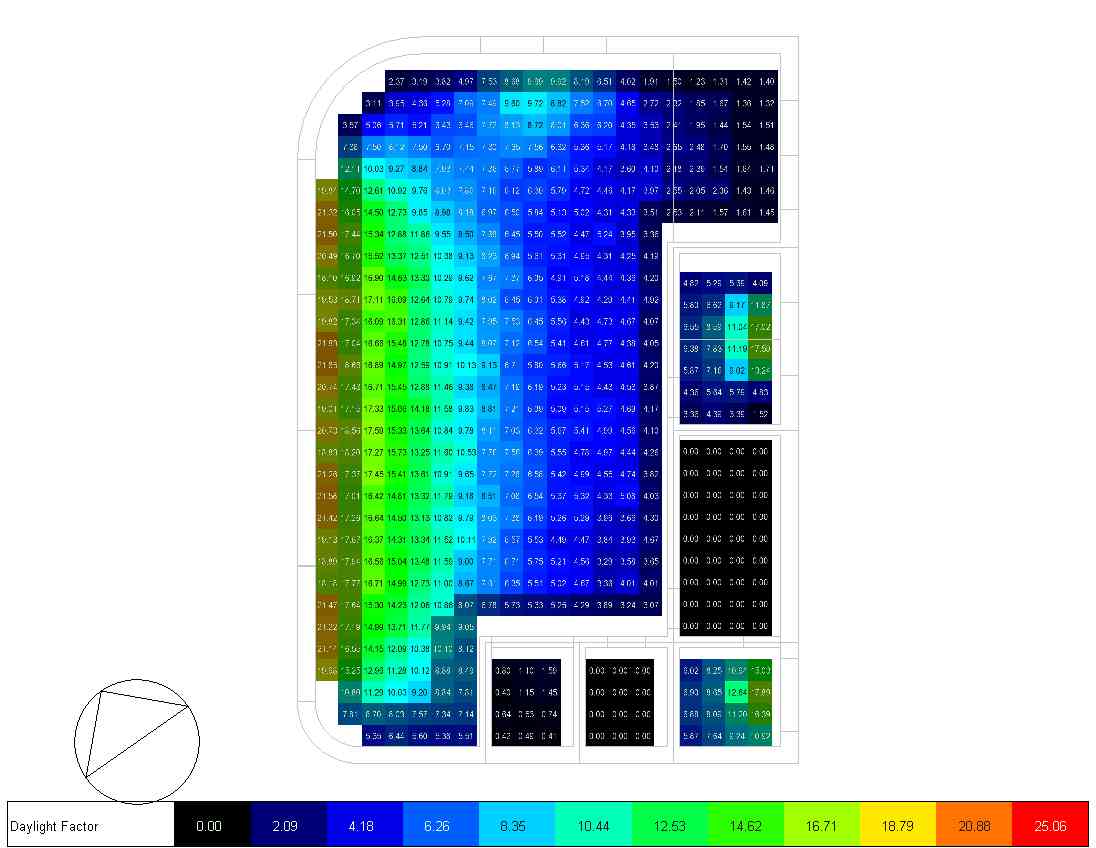
Good daylight makes spaces healthier and cuts lighting energy — but "good" has to be measured. LEED's daylight credit moved years ago from simple daylight-factor rules to climate-based annual simulation, judged on two metrics: sDA and ASE. Understanding both (and glare) is the key to earning the credit without creating a glare problem.
sDA — spatial Daylight Autonomy
sDA measures how much useful daylight a space gets. Specifically, sDA300/50% is the percentage of floor area that receives at least 300 lux for at least 50% of occupied hours, using a full-year daylight simulation with realistic blind operation. Higher sDA means more of the space is daylit — this is the metric you want to push up.
ASE — Annual Sunlight Exposure
ASE is the counterweight. ASE1000/250 is the percentage of floor area that receives at least 1000 lux of direct sun for more than 250 hours a year. Too much direct sun means glare and overheating, so ASE is the metric you want to keep down (LEED targets roughly ≤10%). The art of daylight design is maximizing sDA while controlling ASE — usually through shading, glazing selection and orientation.
Glare
ASE limits direct sun, but visual comfort can also be assessed more directly with glare metrics such as Daylight Glare Probability (DGP) at key viewpoints. This matters where occupants face windows — offices, classrooms, reading areas — and informs shading and blind strategies.
How the credit is earned
The modeled LEED daylight option uses a Radiance-based annual simulation to compute sDA and ASE across the regularly occupied floor area. Hitting the sDA threshold (with ASE under its cap) earns the credit — with higher sDA earning more points. Because the result depends on geometry, glazing, shading and surrounding context, it pays to test it during design, not after.
Beyond LEED
Daylight analysis also supports the WELL Building Standard's Light concept and informs circadian-lighting and energy strategies. Done well, it links three goals at once: certification points, occupant wellbeing and lower lighting energy.
Need a daylight study for LEED or WELL?
We run climate-based sDA/ASE and glare analysis and advise on shading and glazing to earn the credit while controlling glare. Let's talk about your project.
Get in touchThis article is general guidance. Daylight credit requirements are defined by the applicable LEED rating system — always confirm current thresholds for your project.