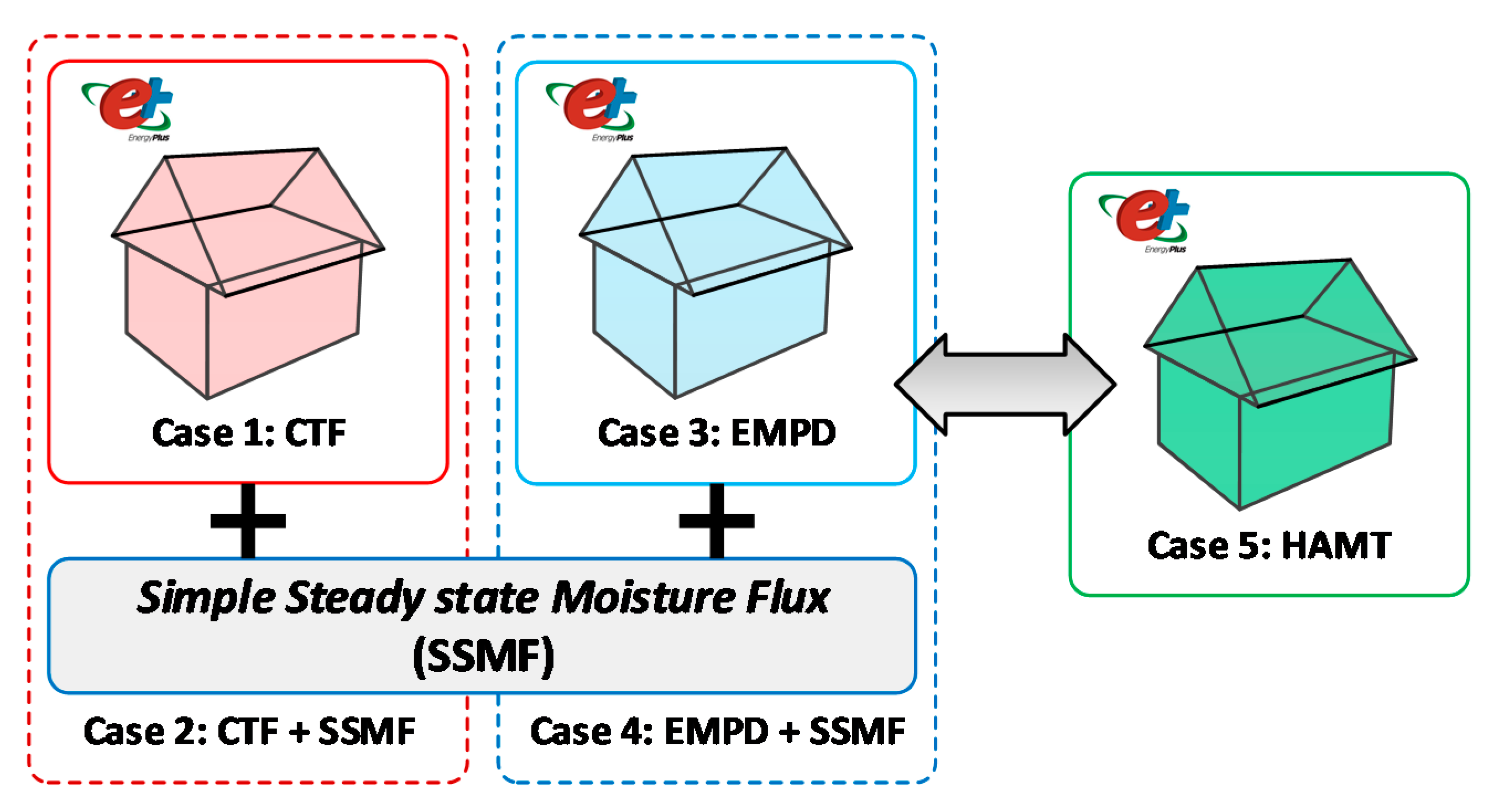
Most energy models treat building surfaces as dry — they move heat, but ignore moisture. In reality, walls, plaster and finishes constantly absorb and release water vapour, which affects indoor humidity, latent loads, comfort and even condensation risk. EnergyPlus offers several ways to handle this, trading accuracy against run time. This article compares them using the five-case framework above.
Why moisture matters in energy modelling
Ignoring moisture can skew predicted humidity, latent cooling loads and dehumidification energy — and it tells you nothing about interstitial condensation inside the construction. Capturing the moisture buffering of interior surfaces gives more realistic indoor humidity and HVAC behaviour, which matters for comfort, mould risk and equipment sizing.
The models at a glance
CTF — Conduction Transfer Function
The default EnergyPlus algorithm. It solves sensible heat conduction through surfaces efficiently, but treats them as having no moisture storage. Fastest to run; blind to moisture buffering.
EMPD — Effective Moisture Penetration Depth
A simplified moisture model that lets interior surfaces absorb and release vapour within a thin "effective" layer. It captures the moisture buffering of finishes and its damping effect on indoor humidity — at a small computational cost. It does not resolve moisture through the full thickness of the construction.
SSMF — Simple Steady-state Moisture Flux
An add-on that introduces a simplified, steady-state moisture flux on top of a CTF or EMPD run (Cases 2 and 4). It's a pragmatic middle ground — adding a basic representation of moisture transfer without the full cost of a coupled hygrothermal solver.
HAMT — Combined Heat and Moisture Transfer
The most detailed option: a fully coupled, one-dimensional finite-element model that simulates heat and moisture together through every layer of the construction, to and from both the indoor and outdoor environments. It produces temperature and moisture profiles inside walls — ideal for assessing interstitial condensation — but is the most computationally demanding and usually needs short time steps.
Side-by-side
| Model | Moisture captured | Detail | Run time |
|---|---|---|---|
| CTF | None (sensible heat only) | Low | Fastest |
| CTF + SSMF | Simple steady-state flux | Low–Medium | Fast |
| EMPD | Surface buffering | Medium | Fast |
| EMPD + SSMF | Surface buffering + flux | Medium | Moderate |
| HAMT | Full coupled heat & moisture, per layer | Highest | Slowest |
Why compare them?
Running the same building across all five cases — with HAMT as the reference — shows how much accuracy you gain (or lose) with each simpler method, and at what computational cost. That trade-off study is how you justify using a fast model for a large parametric study, or a detailed one where moisture really drives the result.
How to choose
- CTF — quick sensible-only studies where moisture isn't a driver.
- EMPD — when indoor humidity, latent loads or moisture buffering matter, but full hygrothermal detail isn't needed.
- SSMF add-on — a lightweight way to bring moisture flux into CTF/EMPD runs.
- HAMT — when interstitial condensation, durability or detailed wall moisture profiles are the question.
Need moisture-aware energy modelling?
We build EnergyPlus models with the right heat-and-moisture method for your question — from fast CTF/EMPD studies to full HAMT condensation analysis. Let's talk.
Get in touchThis article is general guidance. Model behaviour depends on inputs, materials data and climate; always validate the chosen approach for your specific project.