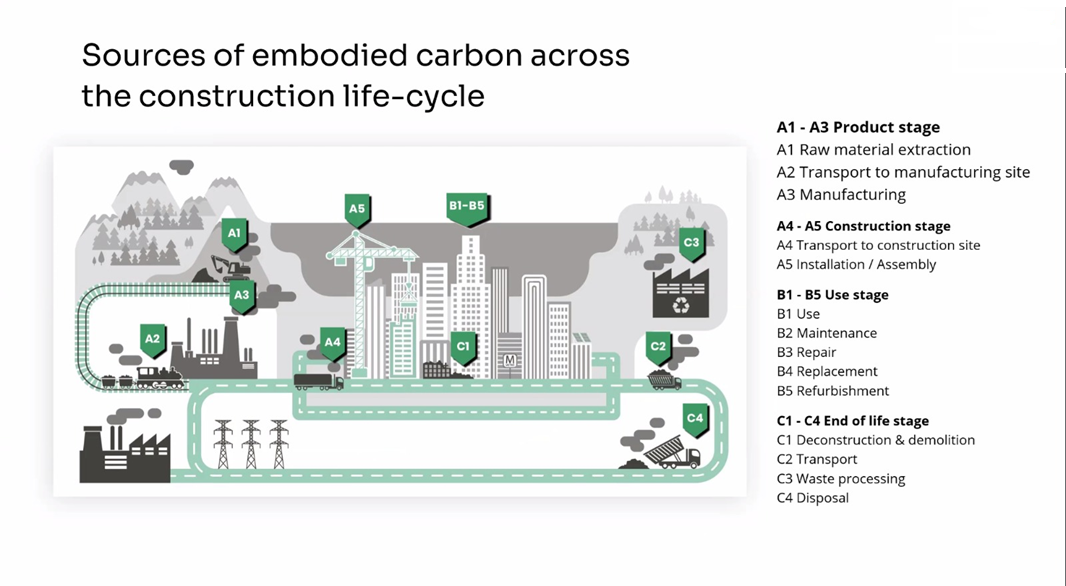
With LEED v5, the green-building conversation has shifted decisively from operational energy to carbon — including the embodied carbon locked into your materials. For the first time, measuring embodied carbon through Life-Cycle Assessment (LCA) is a requirement, not an optional credit. Here's what that means for your project.
What is embodied carbon (and LCA)?
Embodied carbon is the greenhouse-gas emissions associated with making, transporting, installing, maintaining and disposing of building materials — everything except the energy the building uses in operation. Life-Cycle Assessment is the method used to quantify it across the building's life-cycle stages (A1–A3 product, A4–A5 construction, B1–B5 use, C1–C4 end of life), usually expressed as Global Warming Potential (GWP) in kg CO₂e.
The new prerequisite: MRp2 — Quantify & Assess Embodied Carbon
Every LEED v5 BD+C project must now satisfy Materials & Resources Prerequisite 2 (MRp2). In practice, your team must:
- Measure the embodied carbon (GWP) of the structure, enclosure and hardscape — concrete, steel, masonry, insulation, aluminium, wood, cladding, glass and asphalt.
- Calculate cradle-to-gate (A1–A3) emissions — each material's GWP per unit multiplied by its quantity.
- Identify the top three materials contributing the most embodied carbon.
- Describe the strategies used (or planned) to reduce them.
LCA / embodied-carbon software such as One Click LCA is accepted for producing these A1–A3 results.
The credit: MRc2 — Reduce Embodied Carbon (up to 6 points)
Beyond simply measuring, the Reduce Embodied Carbon credit rewards actual reductions in the GWP of your structure, enclosure and hardscape — worth up to 6 points. LEED v5 offers three compliance pathways:
- Whole-Building LCA — a full cradle-to-grave model comparing a baseline and proposed design.
- EPD-based analysis — using Environmental Product Declarations for chosen materials.
- A5 construction-emissions tracking — accounting for emissions during construction.
Where the carbon hides: concrete, steel & masonry
LEED v5 puts the spotlight on the most carbon-intensive materials — typically concrete, masonry and steel, which dominate a building's embodied footprint. The biggest wins usually come from optimizing the structure: lower-carbon concrete mixes, recycled-content steel, right-sized members, and material-efficient design.
What this means for project teams
Start early. Because MRp2 is a prerequisite, an LCA can no longer be a late add-on — it needs to inform structural and material decisions during design, when you can still influence them. Pairing an embodied-carbon LCA with the operational-carbon work LEED v5 also requires gives you the full carbon picture in one coordinated effort. (See our companion article on LEED v5 energy modeling.)
Need an LCA for your LEED v5 project?
We run whole-building Life-Cycle Assessments and embodied-carbon studies (One Click LCA) to meet MRp2 and earn MRc2 points. Let's talk about your materials.
Get in touchThis article is general guidance and reflects information available at the time of writing. LEED v5 requirements are defined by USGBC and may be updated — always confirm current requirements in the official rating system for your project.