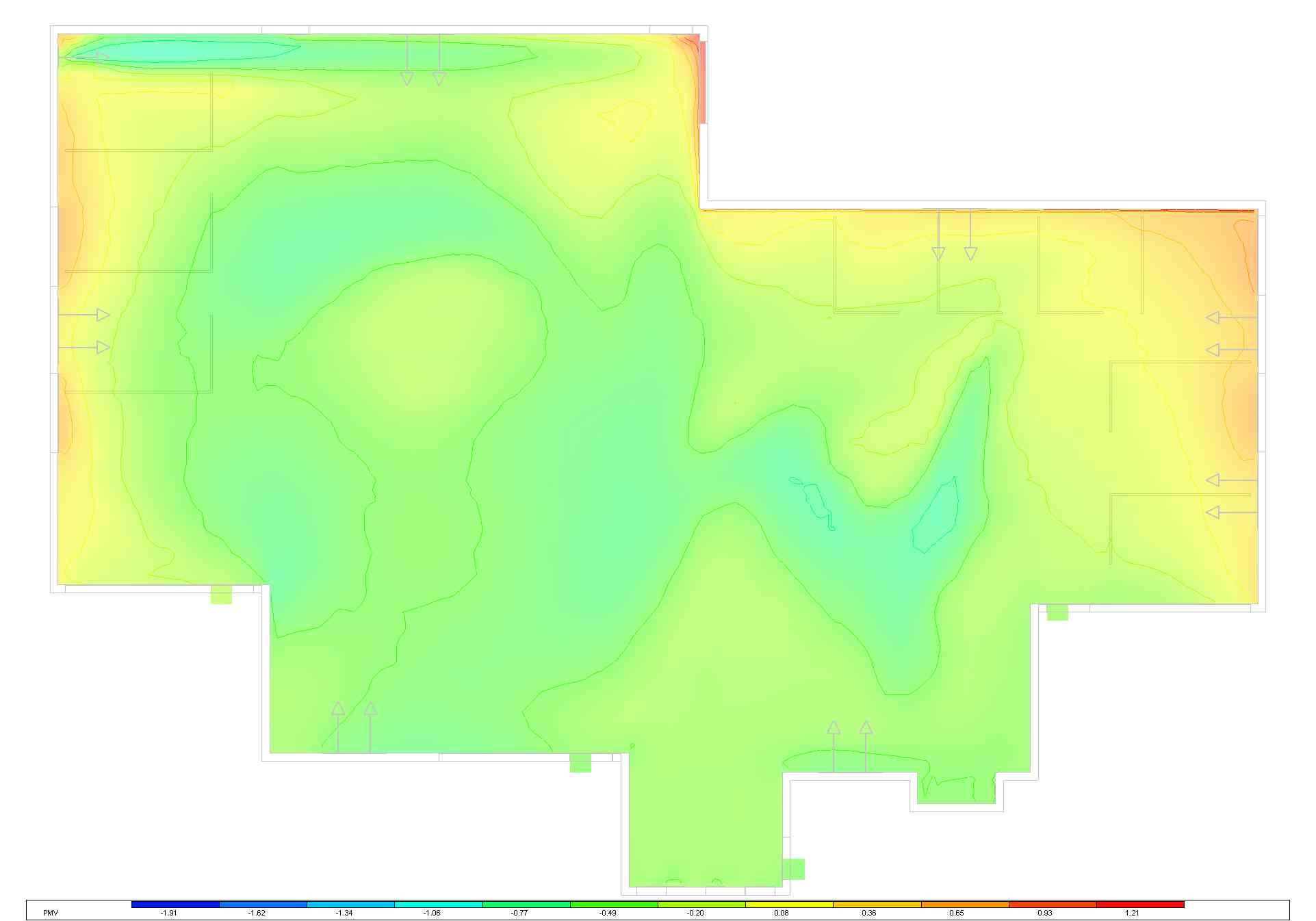
A building can hit every energy target and still feel uncomfortable. Thermal comfort modeling answers a human question: will people actually feel comfortable in this space? The standard framework for that is ASHRAE 55, built on two indices — PMV and PPD.
The six factors of comfort
Comfort isn't just air temperature. ASHRAE 55 recognizes six factors that together determine how warm or cool a person feels:
- Air temperature and mean radiant temperature (surfaces around you)
- Air speed and relative humidity
- Metabolic rate (activity) and clothing insulation
Two of these are personal and four are environmental — which is why a model has to consider the whole picture, not just the thermostat setpoint.
PMV and PPD
PMV (Predicted Mean Vote) places conditions on a thermal-sensation scale from −3 (cold) through 0 (neutral) to +3 (hot). PPD (Predicted Percentage of Dissatisfied) converts that into the share of occupants likely to be uncomfortable. Even at perfectly neutral conditions, PPD never drops below about 5% — you can't please everyone — so the goal is to stay within an acceptable band.
The ASHRAE 55 comfort zone
ASHRAE 55 defines an acceptable comfort range, commonly taken as PMV between −0.5 and +0.5 (about PPD ≤ 10%). Comfort modeling checks how much of the occupied time and space stays inside that band, and flags zones at risk — perimeter areas near glazing, double-height spaces, or rooms with high solar gain. For naturally ventilated buildings, an adaptive comfort model is used instead, recognizing that occupants tolerate wider ranges when they can open windows.
Why it matters for certification
Comfort modeling supports the LEED Thermal Comfort credit and the WELL Building Standard's Thermal Comfort concept, and it's central to overheating checks. Practically, it also de-risks design: catching an uncomfortable zone in the model is far cheaper than fixing complaints after handover.
Need a thermal comfort study?
We run PMV/PPD comfort analysis to ASHRAE 55 (and adaptive/overheating assessments) for LEED, WELL and design assurance. Let's talk about your project.
Get in touchThis article is general guidance, not a substitute for the published standard or advice for a specific project. Always verify requirements with ASHRAE 55 and the applicable rating system.