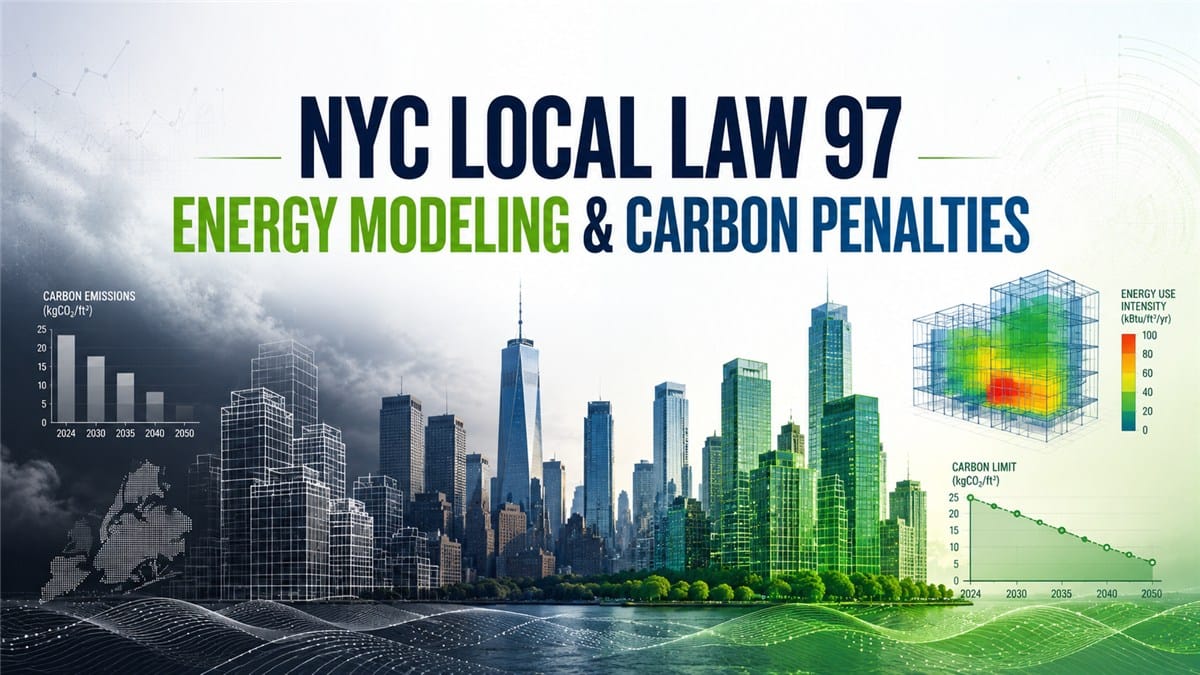
New York City's Local Law 97 is one of the most consequential building-emissions policies in the US. For most buildings over 25,000 gross square feet, it sets annual carbon limits that get progressively stricter — and exceeding them carries real financial penalties. Energy modeling is how owners see the problem coming and plan their way out of it.
What LL97 requires
LL97 (part of NYC's Climate Mobilization Act) caps the greenhouse-gas emissions of covered buildings, based on their floor area and occupancy type. Owners must report emissions annually, certified by a registered design professional. The limits tighten in steps: the 2024–2029 period is the first, and the 2030–2034 limits are substantially stricter, on a path toward an 80% citywide reduction by 2050.
The penalties
Buildings that exceed their limit face a penalty of $268 for every metric tonne of CO₂e over the cap, every year. For a large building that's over the line, that can run into six or seven figures annually — and the gap widens automatically as the 2030 limits drop. That recurring exposure is what makes early planning so valuable.
Where energy modeling comes in
Emissions under LL97 are calculated from a building's energy use multiplied by fuel-specific emission factors — so the path to compliance runs through energy. An energy model lets owners:
- Forecast emissions against the 2024–2029 and 2030 limits to see when (and by how much) a building goes over.
- Test decarbonization measures — electrification, heat pumps, envelope upgrades, controls, on-site solar — and quantify the carbon and penalty reduction of each.
- Prioritize capital by comparing the cost of upgrades against years of avoided penalties.
The takeaway
LL97 turns carbon into a budget line. The owners who do best treat it as a planning problem now — using a model to map their trajectory and sequence retrofits — rather than waiting for a penalty notice. It pairs naturally with new-build work under the 2025 NYC Energy Code and with existing-building retrofit modeling.
Have a building facing LL97 limits?
We model LL97 emissions, forecast penalties against the 2024–2029 and 2030 caps, and test decarbonization measures to bring buildings into compliance. Let's talk.
Get in touchThis article is general guidance and reflects information available at the time of writing. LL97 limits, factors and penalties are defined by the NYC Department of Buildings and may change — always confirm current requirements for your building.