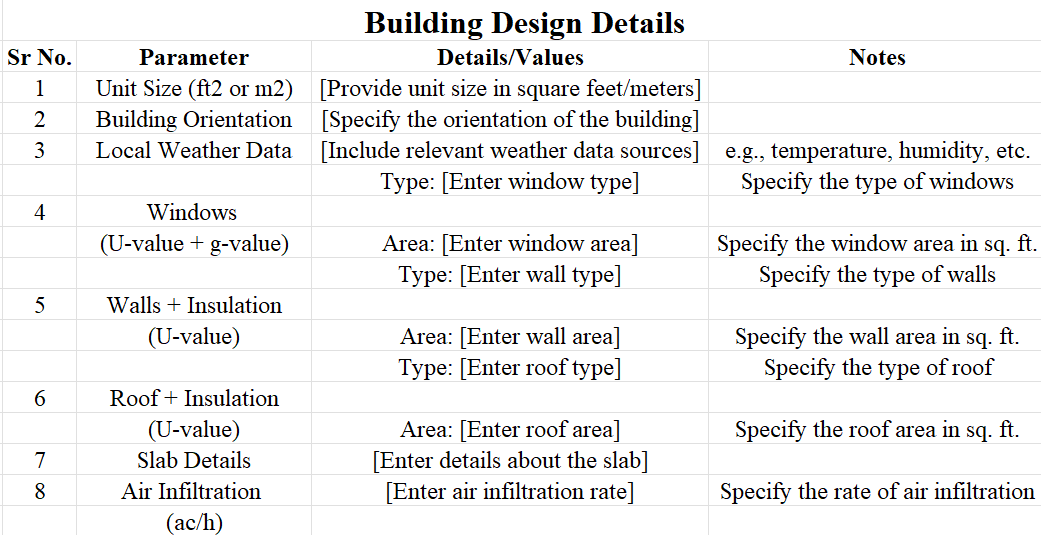
The single biggest factor in a fast, accurate energy model isn't the software — it's the quality of the inputs. The more complete the information a modeler receives up front, the fewer assumptions are needed, the fewer review comments come back, and the stronger the final submission. Here's the practical checklist of what to provide.
1. Geometry & drawings
Architectural plans, sections and elevations (PDF or CAD/BIM), plus an area schedule and the building's orientation and location. These define the geometry, floor areas and how the building sits relative to the sun.
2. Envelope
Construction make-ups and performance for walls, roof and floors (U-values / insulation), and glazing specs — window U-factor and SHGC, frame type and areas (or window-to-wall ratio). Shading devices and any adjacent overshadowing matter too.
3. HVAC & services
The HVAC system type, equipment efficiencies, ventilation rates and controls (mechanical schedules or drawings if available), plus service hot water details. This is often where models live or die, so the more specificity the better.
4. Lighting & loads
Lighting power densities (or a fixture/lighting schedule) and lighting controls, plus plug/process loads. These drive internal gains and a large share of energy use.
5. Operation & intent
Occupancy and operating schedules, any on-site renewables, and — critically — the target: which code, certification (LEED/WELL) or incentive (179D) the model must satisfy. The pathway shapes how the model is set up from day one.
Don't have everything yet?
That's normal, especially early in design. A good modeler will use sensible, documented assumptions for whatever's missing and refine as information firms up. Providing what you have early is far better than waiting for a "complete" set — the model can grow with the design. (Architects: see what to provide and when.)
Ready to start a model?
Send us what you have — drawings and the target code or certification — and we'll scope the model and flag any gaps. Quote in one business day.
Get in touchThis article is general guidance. Exact input requirements depend on the model's purpose and the applicable code or rating system.