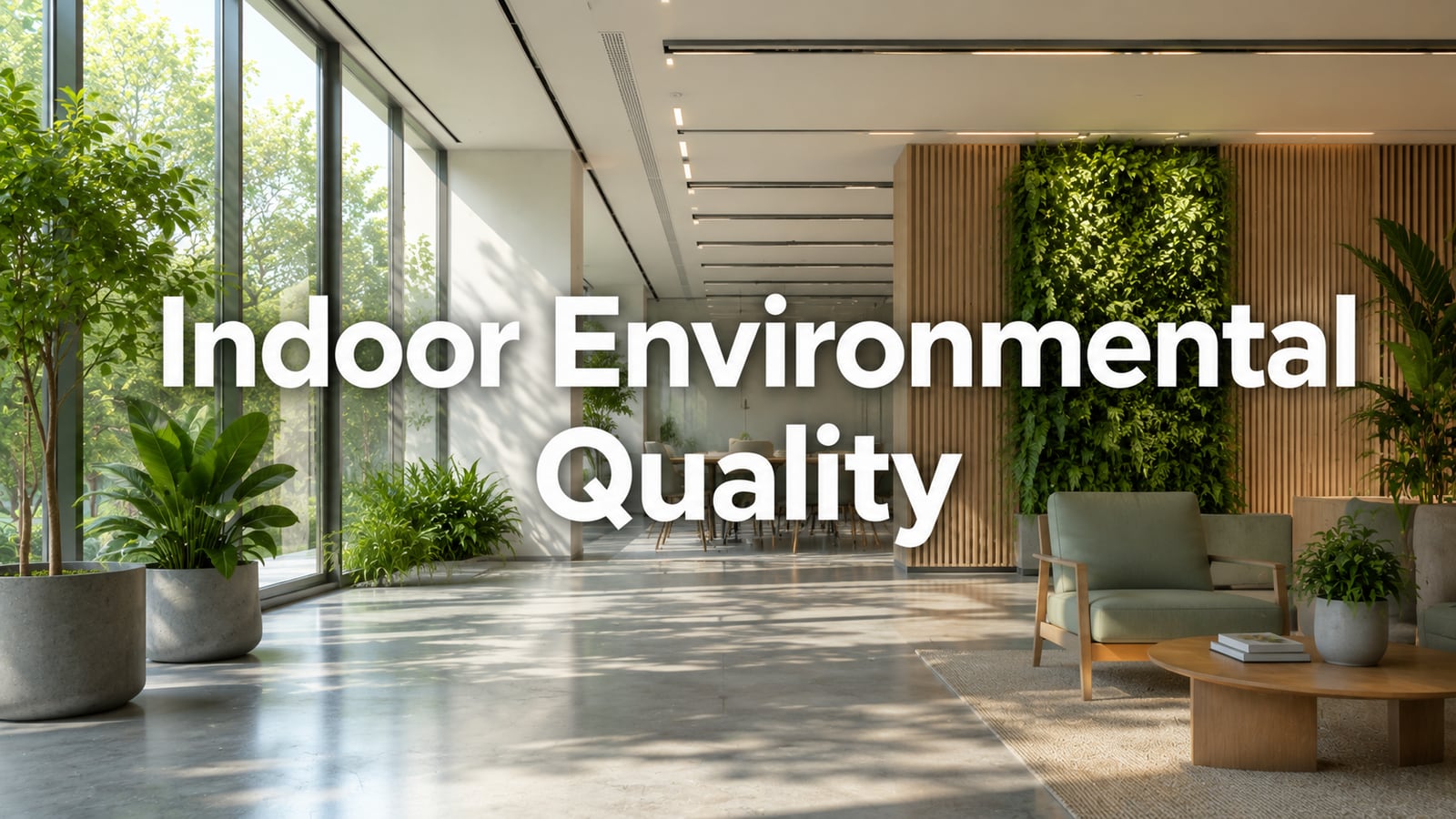
Decarbonization runs through most of LEED v5, but a full quarter of the system is about quality of life — and that is where Indoor Environmental Quality (EQ) lives. People spend the vast majority of their lives indoors, and this category covers the air they breathe, the light they work in, the sounds around them and how comfortable and included they feel. This is the seventh and final core category in our series walking through LEED v5.
Knowing who the building is for
A notable v5 addition is the Occupant Needs Assessment — understanding who actually uses the building regularly and whether they face any specific or regional health hazards. It sits alongside the long-standing fundamentals: fundamental air quality, construction indoor-air-quality management, and a no-smoking / no vehicle-idling requirement. The message is that healthy space starts with knowing your occupants, not just hitting generic targets.
Air quality you have to prove
The biggest practical change is that air quality must now be demonstrated, not assumed. The old "flush-out" option is gone; instead projects validate performance through air-quality testing or continuous sensor-based monitoring of pollutants such as CO₂, PM₂.₅ and VOCs. Combined with the Low-Emitting Materials credit — limiting the VOCs that paints, adhesives, flooring and furniture release — the category attacks indoor pollution at both the source and the measurement end.
The Occupant Experience credit
LEED v5 consolidates several familiar comfort credits into a single, broader Occupant Experience credit, bringing together:
- Thermal comfort — conditions that keep occupants comfortable (see our guide to PMV/PPD and ASHRAE 55);
- Daylight and quality views — access to natural light and outside views (see daylight analysis: sDA, ASE & glare);
- Interior lighting quality and control;
- Acoustic performance — managing noise and reverberation.
Holistic considerations such as biophilia and adaptability round out the experience.
Health, equity and inclusion
EQ is also where LEED v5's equity focus shows up at the human scale. New credits around accessibility and inclusion — connected to the project-wide Human Impact Assessment introduced in the Integrative Process — push teams to design spaces that work for a genuinely diverse range of people. Much of this overlaps with health-focused standards like WELL, making the two natural companions on a project.
What it means for project teams
Plan for verification, not just design intent: budget for air-quality testing or permanent monitoring, and specify low-emitting materials from the start. Use daylight, thermal-comfort and acoustic modelling early to balance views and glare, comfort and energy. And treat the occupant needs assessment as a real design input. Done well, these measures produce healthier, more productive spaces — the part of LEED v5 occupants feel every day.
Modelling comfort, daylight and air quality for LEED v5?
We run daylight, thermal-comfort and ventilation analysis that supports LEED v5's Indoor Environmental Quality credits — and WELL alongside it. Let's talk.
Get in touchThis article is general guidance and reflects information available at the time of writing. LEED v5 requirements are defined by USGBC and may be updated — always confirm current requirements in the official rating system for your project.